comments 2

Tragic conflict in the heart of Bangkok

It was almost exactly a year ago that I reviewed the documentary film Burma VJ, a film that went on to be nominated for an Academy Award this year. The film used documentary footage and reenactments to recount the dramatic monk-led uprising of September 2007 that took place in Burma, also known as Myanmar.

I couldn’t help but think about Burma VJ today – and its footage of the Burmese government’s bloody crackdown on protesters – as I viewed these photos, from the Boston Globe’s Big Picture, photos that document the current civil unrest in Bangkok, Thailand.

From the Boston Globe: Protests Turn Deadly in Bangkok

As a student of the conflict in Burma, Bangkok used to be a city I merely traveled through. I knew precious little about it. But, over time, it has become a place I care about, most importantly where I met people who have befriended and inspired me. Just check out some early episodes of DdTv to meet some of the great folks living in the city.

Bangkok wasn’t supposed to be the place where this happened – where protesters lob molotov cocktails at buildings. Where piles of tires become blockades on busy streets – or, lit, become burning masses shielding protesters from military and police. And it is definitely not supposed to be the place where the military snipers shoot from rooftops.

But … that is precisely what Bangkok is today. Dozens are dead, journalists have been shot, bullets have been exchanged in the streets. A renegade general, shot by a sniper four days ago, succumbed to his wounds and died this morning. The whole situation is sticky, complicated and bloody. But most of all, sad.

In the age of Twitter, I’ve been reading news articles as the violence spirals out of control, but mostly I’ve been waking in the morning and finding out, via Twitter, what’s happened that day in Thailand, 12 hours ahead. Every morning my heart has grown more sad with the news. How will this all end? No one seems to know.

I don’t have intelligent analysis, but I did start a Twitter list of folks tweeting (at least partly in English) about what’s currently happening in Bangkok. Please message or @ me if you have suggestions for the list.

Friends in Bangkok, I’m thinking of you.

comment 1

Reflections from the Five Boro Bike Ride

Today, I rode my trusty Dutch bicycle through four of NYC’s five boroughs for the Five Boro Bike Tour. Due to a pressing workload I didn’t make it all the way to Staten Island, but I still had an amazing time.

Unlike most of the 32,000 official participants in the bike ride, I didn’t wear spandex nor an official green race vest. I attached my vest to the front of my bicycle, and wore a cool Sunday outfit of a linen skirt and white shirt. My three cycling companions also bucked the spandex, wearing streets clothes to prove that you don’t need to have special gear to enjoy a bike ride.

I rode my elegant black steed, a vintage-style Dutch bicycle. It’s single-speed, which slowed me a bit on all the bridges, but was otherwise as comfortable and swift as it could be. It also brought comments – “beautiful bicycle” – “nice day for a ride” – and “That’s what I’m talking about!” when I was cruising down the Queensboro Bridge, chocolate chip cookie in hand. Perhaps the best moment was when I was crossing the Pulaski Bridge from Queens to North Brooklyn, and a man started speaking to me in Dutch. I had to tell him I didn’t speak the language but am a fan of their bicycles. What fun.

I saw a few fixies but otherwise, no other bikes quite like mine. Although it was incredible to be among so many fellow cyclists – taking over 6th Ave, Central Park, the FDR Parkway and more, next time, I hope to see a few more Dutch bicycles – sitting upright, no cramped shoulders or arms, it is an incredible way to see the city.

Me and my bicycle in McGolrick Park. Photo by Dimitry Gudkov.

comment 0

Spring morning

One of my favorite poems since I was quite small. It has been on the tip of my tongue lately.

Spring Morning by Alan Alexander (A. A.) Milne

Where am I going? I don’t quite know.
Down to the stream where the king-cups grow-
Up on the hill where the pine-trees blow-
Anywhere, anywhere. I don’t know.

Where am I going? The clouds sail by,
Little ones, baby ones, over the sky.
Where am I going? The shadows pass,
Little ones, baby ones, over the grass.

If you were a cloud, and sailed up there,
You’d sail on water as blue as air,
And you’d see me here in the fields and say:
“Doesn’t the sky look green today?”

Where am I going? The high rooks call:
“It’s awful fun to be born at all.”
Where am I going? The ring-doves coo:
“We do have beautiful things to do.”

If you were a bird, and lived on high,
You’d lean on the wind when the wind came by,
You’d say to the wind when it took you away:
“That’s where I wanted to go today!”

Where am I going? I don’t quite know.
What does it matter where people go?
Down to the wood where the blue-bells grow-
Anywhere, anywhere. I don’t know.

comment 0

Deconstructing “Voiceless”

Yesterday I had the pleasure of speaking on a panel with great speakers on an engaging theme. The only problem was the name:

“Tweets & Blogs: Voices for the Voiceless”

It’s a sexy title. It immediately conveys social networks, new tools and marginalized people. It speaks to the need to expand the conversation. And it’s the kind of title that will get university students to turn out .. and they did. The room had well over 70 people in it.

Here’s my problem: Have you ever met someone who is voiceless? I haven’t. I’ve met people who communicate through languages I don’t understand, who use sign language or speak with the aid of an electronic machine, but I’ve never met a person without a voice. Not in a refugee camp, slum or rural village, not at a guard desk or janitor’s station in a hall of power.

The real issue is not people being voiceless, the issue is not listening. By using the term “voiceless” we emphasize the (perceived) shortcomings of marginalized people rather than condemn the structural injustices that might prevent voices from being heard. New technology does indeed make it more possible than ever to amplify people’s voices. So the questions I am interested in are:

Why are some voices “heard” less than others? Who should be listening? How can we amplify voices that need to be heard – and who decides which voices are valuable or not?

All of these questions are particularly relevant to me this week, as I work on a full application for Project Einstein Indianapolis to the Knight News Challenge. Project Einstein Indy is a community media project training the young Burmese refugees in Indianapolis in photography and storytelling. Our goal is to facilitate dialogue between the refugee youth and their classmates, in a place where there has been a lot of tension and misunderstanding between different groups. We’re using photography to transcend the language barrier, to stimulate creative self-expression and as a tool for more deep connections.

More broadly, I hope our work at Digital Democracy can deconstruct the idea that people are voiceless, and instead, empower the youth and community groups we work with to amplify their own voices both locally and globally.

Despite Twitter, blogs and other social media, there are still too many people talking for communities rather than talking with them. I was incredibly privileged to join a youth journalism program called Y-Press at the age of 13 that trained me how to think critically and ask good questions. That training was reinforced by opportunities to interview young people around the world and produce journalism pieces that amplified their voices into mainstream media. Working at Y-Press taught me that young people have voices – it’s adults who don’t always listen.

***

Speaking of Twitter, the title of the panel also sparked a great conversation on the medium between Digital Democracy, Sam Gregory, Lina Srivastava, Audacia RayBrian Conley. Brian wrote his own blog post on the subject … check out it and the great comments.

comment 0

Mobiles hidden in monk’s robes

My three-part report on the use of mobiles inside Burma and around its borders just published on MobileActive.org, the best resource (on or off-line) for all news pertaining to mobiles for social change. What story does it tell?

On Sept. 26, the protests were still going strong. It was 11 am, and Aung Aung Ye was juggling two computers and a mobile phone from his office in Thailand. That morning he was on his mobile talking with contacts in Burma’s commercial capital, Rangoon. At 1:34 am EST, he told me that more than 10,000 people had gathered near Traders Hotel in downtown Rangoon.

By 1:40, the mood, still palpable electronically, changed. He had received frantic calls – the military had begun using tear gas and bullets against the peaceful demonstrators. His status message read, “Now, shooting in North/Oakalapa.” Two minutes later, it changed again – “Don’t brake my heart into a million pieces.”

Read the entire article here.

comments 2

“What do you think I fought for on Omaha Beach?”

“I was raised on the idea that all men are created equal and I never forgot that. … That’s what we fought for in WWII – the idea that we could be different but still be equal.”

Tomorrow, voters across Maine will decide whether their fellow citizens can keep the legal right to marry whom they choose. The issue is politically divisive, fraught with religious undertones and fear. In an age when divorce rates are so high, and so much has changed the social under, it’s easy to see how scare tactics can confuse people and drive people to vote against equality at the polls. Much has been said, yet I wonder how much dialogue transpires in an environment of distrust and politicized discussions.

For me it is personal, because the right to marry means nothing to me if my friends – and fellow citizens – are denied it. A month ago I participated with joy and elation in the wedding of my best friend Drew marrying the man he loves. I was blessed to be a part of the ceremony. I am blessed to live in a time that has seen enormous gains in the application of universal human rights. When I think that as recently as 1967, interracial marriage was illegal in much of the United States, I am inspired by how far we have come. More than that, I’m inspired by the stories of those who sacrificed to get us here, from the Lovings to the six same-sex couples of Polk County Iowa. I’m no constitutional scholar, but I know that the community I want to live in starts by recognizing people equally under the law.

And I’m not the only one. Today, I want to amplify one man’s voice – someone who has seen much more than I have. Inspiring testimony from WWII Veteran Philip Spooner.


comment 1

Making friends – my travel tips for West Africa

A couple weeks ago Erik Hershman of White African wrote a great blog post of 15 Travel Tips for Africa, a response to NYT’s columnist Nick Kristof’s travel tips, that, though intended to be helpful, might reinforce stereotypes about the dangers of international travel.

Between Erik’s thoughts and the great comments that follow, there’s a lively conversation and vision of travel – in Africa and elsewhere – that emphasizes flexibility, ingenuity and friendliness.

Reading his post and comments reminded me of my personal ideas on the key things to keep in mind while traveling, particularly drawing on my experiences living in Bamako, Mali. I wanted to repost those tips here, as in many ways they’re really just anecdotes from Mali/the tricks I keep up my sleeve to charm everyone from babies to elders. Most of these tips are universal, but I specify West Africa because the details are the ones that worked for me there. What has worked for you in the countries and places you’ve grown to love?

Shout-out to Patrick Meier for also emphasizing the importance of making friends. From my comment on Erik’s tips:

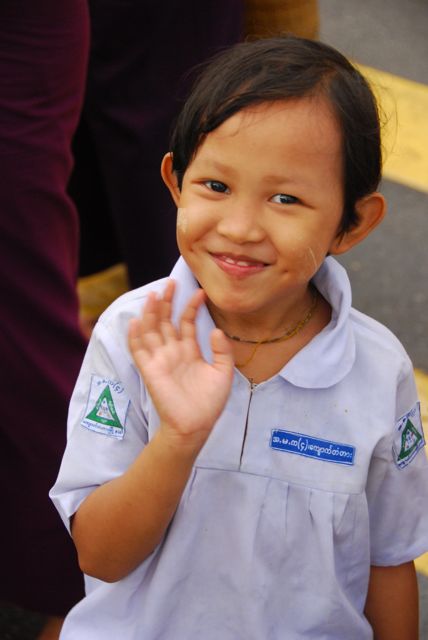
Babies love watching the Zabanchi (from my Flickr stream)

Babies love watching the Zabanchi (from my Flickr stream)

Don’t be afraid to make mistakes: When learning new languages or traversing cultural boundaries, nothing will take you further than failure. If you want to learn how to greet someone in the local language (and you should), the mistakes along the way will be well worth it.

Dance, or, don’t be afraid to let others laugh at your expense: What I’ve learned is that a little self-deprecation goes far in making friends and thwarting would-be-detractors. In Mali, my host family/neighbors loved to watch me dance the “Zabanchi,” which I learned at a street dancing party. I looked ridiculous, and they loved it. Laughter’s the best way to make friends. And friends are the best way to experience a new place.

Eat with your hands: This might not apply in all African countries, but if you’re visiting someplace where folks eat with their hands, you should try it too! I have Bangladeshi friends who swear the food tastes better this way, and in much of Sub-Saharan Africa, it will show respect and a willingness to embrace local culture rather than impose your own. And, if you’ve yet to master the art of eating millet porridge or sauce and rice out of your palm, then you’ll give your hosts a good laugh to boot.

(A tip for female travelers) Go one further on marriage proposals: Yes. If you look like you have a foreign passport, you will get marriage proposals. Sometimes it can be annoying, but I never found the would-be-suitors to actually be threatening. So I developed a response that became a delightful conversation starter. “Sure, but you might have to be husband #2 or 3.” Thus ensues a conversation about local norms that is playfully subversive and nonthreatening. In much of Muslim West Africa, polygamy is practiced, and men can have up to four wives. Rather than saying no (what is expected) when asked to be married, or condemning local practices, I merely threw men off their guard and expectations with my response. Their response usually went something like this:

– Man: But women can’t have multiple husbands!
– Me: Sure they can! We can have up to four.

By the end of the conversation, I never had a man who still wanted to marry me (since I insisted on the multiple husbands) but I did find that they were willing to have a real conversation with me and not just view me as a stereotype, green card or intruder.

(A tip every traveler should follow) Question your own stereotypes: Merely writing some of them down, or, if you’re going on group travel, doing a group exercise on this, is invaluable. We all have them. If you’re willing to admit them to yourself, you’re much more likely to abandon them when you come face to face with proof that there’s more to things than you previously thought.

So, I end my tips with a salute. Erik, I think you’ve done a great job at debunking some of the stereotypes that Kristof’s column unfortunately props up. Africa’s merely the oldest and one of the most ecologically/anthropologically diverse continents on the planet. The tips you’ve recorded and collected include ones that are specific to a place or a climate, but the others – about making friends and traveling smart – are applicable everywhere.

Finally, one tip I forgot to add in my comments but that will take you further than any other act I know: Smile.

comment 1

We Operate Best Together – an inspiring journey

I just donated to support an inspiring project: We Operate Best Together. Morgan Sully, a community technologist with a heart of gold, is embarking on a journey to tell the stories of changemakers and innovators on an upcoming trip to Europe. This May, he helped Digital Democracy as the project champion for Handheld Human Rights. Next, he’s traveling to England, the Netherlands and Norway, and will be doing digital storytelling along the way. I’m proud to support his trip and can’t wait to see what he produces.

He’s also an electronic musician.

Check out his own words about this adventure, and support him on Kickstarter – even a donation of $1 or $5 will help him reach his goal.

comment 1

The Growing Season

What’s more delicious than local produce in season?

From Snore and Guzzle (found via the awesome and inspiring mind behind OrganicNation.tv)

The Growing Season for New York State

Asparagus: May 5th – May 15th
Rhubarb: May 1st – June 15th
Strawberries: June 10th – 30th
Sweet Cherries: July 4th – Aug. 1st
Sour Cherries: July 15th – Aug. 10th
Blueberries: July 4th – Sept. 1st
Red Raspberries: July 5th – Oct. 10th
Purple Raspberries: July
Black Raspberries: July
Currants Red, White and Black: July 5-August 5
Peaches-Yellow and White: mid July – early Sept.
Blackberries: August
Plums: mid August through mid-September
Apples: September-November 1

Although rhubarb is just past, I saw some delicious-looking rhubarb the other day at Eat Records, where I had perhaps the most delicious juice of my life, fresh apricot juice from a nearby farm in New York.

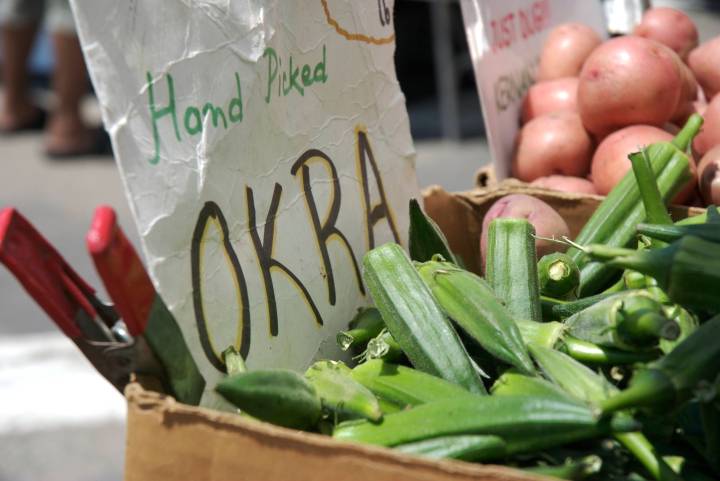
Okra at the farmer's market

Thinking about the growing season reminds me of En Los Campos, the photography/oral history I worked on with my mom and Pam LeBlanc about the lives of teenage migrant farmworkers in the Midwest. It was amazing to travel around the fields of Indiana and Michigan – among the corn, cukes and cantaloupe, interviewing young people – some as young as 10 or 12, others my age (17/18 at the time) with kids of their own.

I learned that every piece of produce that I pick with my hands at a grocers was picked by hand in a field or orchard. It taught me that I want to know when a fruit is ripe, so that I can eat in season with the place where I live. I learned that I want to know who helped get the food from the field to my belly – and to know they were treated fairly along the way.

“If you really want to make a friend, go to someone’s house and eat with him… the people who give you their food give you their heart.” – Cesar Chavez