comments 4

Computers, Freedom & Privacy: Twitter & Dialogue

The opening of the  Computers, Freedom and Privacy conference on Tuesday, June 2 featured Twitter not quite front-and-center, but on a big screen to stage left. Keynote moderator Eric Lichtblau of The New York Times remarked on the novelty of such a screen, explaining it is the first time Twitter has been integrated into this 19-year conference.

This shift seems an apt metaphor for the central tensions between security, privacy and freedom that will be explored over the next three days of the conference, and I really must commend the conference organizers for making these conversations so integral to the conference. Almost a decade into the 21st century, there is much that is undecided on how we as individuals, companies or societies share vs. protect data, the so-called oil of the Information Age.

My biggest takeaway from this morning was Peter Swire‘s observation on for the tension between the Privacy and Web 2.0 movements. As he explained it, for a long time it was the Privacy movement that was viewed as the human rights defenders, “fighting the good fight.” But then he challenged this audience – including many in the Privacy movement – to understand that “for young people, information is empowerment.” Drawing on his experiences with the Obama campaign, he explained that, for 20-somethings, data becomes powerful when it is opened up for citizen use, that social networking is viewed as participatory power … an idea that can seem almost anti-thetical to the original Privacy vision.

During the keynote panel I was struck by this talk of a generational gap. One audience member, Saul Hansell of the NYT, even asked panelist Caroline Fredrickson of the ACLU whether younger people who are drawn to sharing would rather have their information centralized in the National ID program that she opposes. It was a question that reflects poorly on the one who posed it … as a young person, I am frustrated by the idea that we’re any more monolithic in our opinions than any other group, or that any one person should speak for us. Understandably, Fredrickson didn’t have a good answer for Hansell. If he wants to know young people’s opinions, he should query a large (random) sample of them.

But that’s why the decision of the conference organizers to have the Twitter feed on stage is so commendable. Of course we all came to the conference in part to hear and learn from the experts – the pioneers of the Privacy movement who are being featured on stage. But we’re also here to take part in a conversation with one another, and the Twitter feed allows for audience comments to be brought into the larger discussion. And it also means that the Web 2.0 folks that Swire was referencing are able to insert their opinions and questions – in 140 characters – throughout the event. Many of the panelists during Tuesday’s opening sessions made good use of the Twitter feed, and Craig Newmark (@craignewmark), founder of Craigslist, received chuckles when he relayed CFP’s twitter request that Hansell, who was interviewing him over lunch, speak more directly into the microphone.

But highlighting the Twitter feed does not guarantee a conversation. On the opening panel there was much discussion of the generation divide, but little representation of it. I’m curious to see, over the next couple of days, how much younger folks are given space to speak, and how much dialogue takes place – not only in the formal panels and breakouts, but in the hallways, during meals and breaks, and in the evening “Birds of a Feather” meet-ups. What’s clear is that the CFP ’09 Online Visibility Team – who recruited bloggers and others to join the conversation – are committed to sincere dialogue. And that’s something I’m proud to take part in.
comment 1

What do you need?

Yesterday morning, at the opening session of the Computers, Freedom and Privacy conference, Susan Crawford of the Obama administration, kicked off the presentations with a striking anecdote. recent article in the Wall Street Journal quoting 37-year-old homeless man Charles Pitts:

“You don’t need a TV. You don’t need a radio. You don’t even need a newspaper. But you need the Internet.”

On the Street and On Facebook: The Homeless Stay Wired by Phred Dvorak

What do you think? Seems pretty accurate, but the Internet can also be found in many places. And people in much of the world, I could see the statement being phrased differently.

“You don’t need a TV. You don’t need a radio. You don’t even need a computer. But you do need a mobile phone.”

comment 0

Blogging from ‘Creating the Future’ … exploring the tensions between freedom and privacy in the Internet age

Today marks the official opening of the 19th annual Computers, Freedom and Privacy conference. I’ll be live-blogging the next few days thanks to the team behind the conference.

The conference is a timely event, as the Obama administration is making frequent news in this arena, from appointing a Chief Technology Officer & team to a new mandate for the Pentagon to wage cybersecurity. Complicated issues, for sure, and I’m excited to hear the speakers weigh in on topics from censorship to cloud computing. I particularly excited for Thursday, the 20th anniversary of the Tiananmen Square Massacre, when Rebecca MacKinnon will give a keynote, and I’ll be presenting on a breakout panel on Social Network Activism in the US and Beyond.

comment 1

People power + digital video = largest protests in a generation

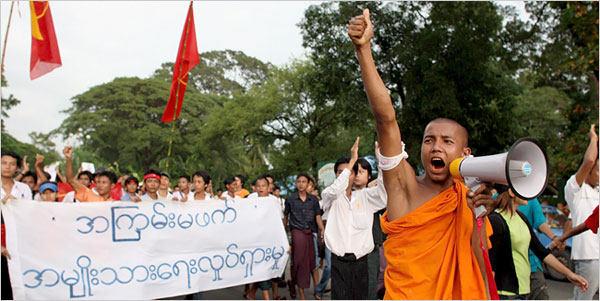
Who knew a feature length film could successfully tell a story through hidden camera footage, blurry images & reenactments? Not to mention a film in which the central character’s face is never revealed? I might have been skeptical before, but not after watching Burma VJ.

Readers who know my involvement with Burmese groups might question my biases, but indeed, I went into the film a skeptic. The subject matter is close to me – I know monks who helped organize the protests of September 2007, the central events of the film. I’ve interviewed and befriended people who fled the country following the crackdown, activists who left behind their families, know others who gave their lives. And so I went into the film with a hope and a fear – hope for the film’s power to raise awareness about a story so important to me, and fear that the film might not adequately tell the story.

How rewarding for my fear to slip away within the first few minutes of the film. Burma VJ elegantly tells the story of the September protests and the video-journalists who documented it. It deserves the awards it’s been getting from Working Films, Full Frame, Sundance and others.

Read more in my review on Tiny Mix Tapes. Kudos to the talented & insightful Judy Berman of Don’t Quit Your Day Job for commissioning me for the review and editing my piece.

free burma

Burma VJ opened Wednesday, May 20 at Film Forum in Manhattan. Check them out and find a way to see the film this summer. You should not miss it.

Of note – Film Forum will be playing Agnès Varda’s The Beaches of Agnès this summer, another one that I anticipate to be a must-see. Varda, in addition to being the “grandmother of French New Wave cinema” also inspired this blog title with her film Les Glaneurs et La Glaneuse – The Gleaners and I.

comment 0

6th Ave without pineapples?

I love pineapples. When I’m working in Thailand, I find nothing more refreshing than a frothy, cool pineapple shake.

But more than pineapples I like the idea of thinking about our food and where it comes from – who picked it? How? How did it get to my hands? What happened to the environment along the way?

Sometimes those questions can be overwhelming. In the United States, and much of the “developed” world, the complex systems that bring food to people’s tables are ones that largely harm the environment and put the humans who handle the food at risk. From meat grown on factory farms to fruit picked by exploited migrant laborers, so much of the food we consume has ethical implications. And even if the food is grown sustainably, and harvested at fair trade wages, what does it mean to consume food that has traveled hundreds or thousands of miles on fossil fuels to land on our plates?

It’s a lot to consider, and I frequently fail to make the most ethical food choices. But I know many inspiring people who are leading by example in the movement for more sustainable food. (Like the Women’s Garden Cycles.) And Mark shared an inspiring thought with me recently:

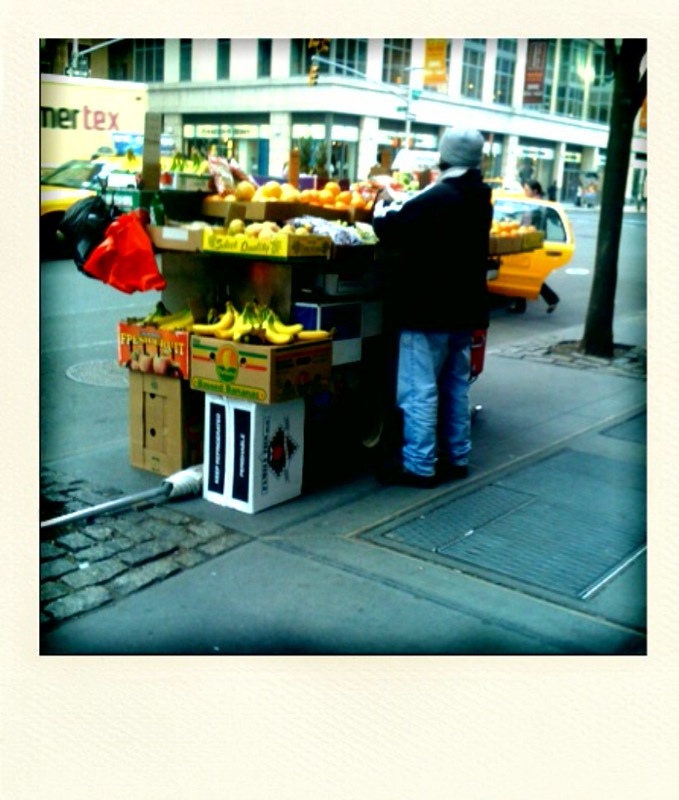
Walking by the fruit seller on 6th Ave, he said to me, “Won’t it be great when we can no longer buy pineapples on the street in New York?”

pineapples-on-6th-ave1

I thought for a moment about what he meant, and realized I whole-heartedly agreed. It’s not that I have a personal vendetta against pineapples, or that I want them to be impossible to procure in Manhattan. But it shouldn’t be quite so easy to pick up a piece of the tropics in temperate climes, no matter how delicious. Pineapples travel too far, pineapple workers suffer too much, and pineapple production is connected to environmental degradation.

But my aim isn’t to pick on pineapples. As hefty items with documented labor and environmental concerns, they are simply easy targets. Anyone who’s ever eaten a mango ripe off a tree can tell you not to bother with one from a New York grocer. And, having tasted an apple in Mali, I realized I could wait till I returned to harvest season in the US. What I’m really getting at is what so many great food writers & thinkers are talking about lately (Michael Pollan, Alice Waters, Barbara Kingsolver & others). When we eat food that’s local and in season, not only do we reduce our carbon imprint, we have the ability to better monitor labor standards, and we get produce that is healthier and tastier. It doesn’t mean we should never eat pineapple, but it does mean thinking twice before consuming, and savoring those rare bites as special, not standard.

Of note – For more information on how much farmworkers have suffered from the corporate pineapple industry, check out The Sour Taste of Pineapple by the International Labor Rights Forum.

comment 0

Keeping the beat – DC’s drum circle

In August ’07, Mark and I spent a series of Sundays heading to Malcolm X park for the weekly drum circle. If you have ever lived in DC you probably know it – the afternoon gatherings of dozens of folks, many of them serious musicians, some who’ve lived in the city all their life, others coming from Brazil, Ghana, Nigeria, Nicaragua, etc.

We had an amazing time interviewing and filming for it, and thanks to production, editing and music from Liz, Nadia and Kaiton, we finally have it up on Current.com.

Watch it, vote for it … we have two more days to garner enough votes to get it on Current TV!

comment 0

Orwell the blogger

Does anyone else read George Orwell’s blog? I think it’s a brilliant project from The Orwell Prize. They started posting Orwell’s journal entries on Aug. 9, 2008 … exactly 70 years after he began a domestic journal on Aug. 9, 1938. The blog includes both domestic observations – how many eggs were laid by his chickens- and political ones, set against the build-up to WWII from his vantage point in Morocco.

The project will continue until 2012 (1942), and an entry gets posted for every day he wrote an entry 70 years before.

It’s intriguing on many levels – what new significance does a journal take 70 years later? What insight does it provide?

I’m personally delighted by how often he talks about the wheat, the lavender, the eggs.

Below is his entry from Jan. 14-17, 1939

14-17.1.39 [1]

By orwelldiaries

Four eggs (about 4 of the hens now broody).

Saw a stork standing among the ibises the other day. It is enormous – English heron would look small beside it.
Greenfinch evidently exists here as well as the goldfinch, both as in Europe.

Broad beans grown round here are very good, no black fly at all. It seems tangerines are damaged by frost though ordinary oranges are not.

[1] Orwell mistakenly gave the year as ‘37’ for 14.1.39 and 17.1.39

I love that detail about the year. My hypothesis? When writing about these natural details, it was easier to lose sense of time. His next entry, posted Jan. 27, ’39, involved more political details, and a sense of place. I wonder whether it was harder, for that entry, to forget that it was 1939.

comment 0

Konono no 1

My dear friend Kat took me to see Konono no 1 at the Black Cat in April, 2007.

I fell head over heels for the home-made thumb pianos (likembé), the creative rhythms and the frenetic whistling. Most of all I fell in love with Mingiedi, the band’s founder and ringleader. You’ll see him in the pink shirt.