comment 1

Bedtime Poems … an experiment

I’m interested in how we can use communications technology to transcend the ordinary and forge moments of deep connection, in the context of our fast-paced, busy lives.

Poetry occupies a special place in my heart, but poetry doesn’t always occupy the space I would like it to in my life. Books on the shelf – paper on wood – are silent sentinels. Poetry read aloud gains movement through the breath, takes on new meaning in the space between the reader & the listener’s interpretations.

I want to experiment with how modern communications tools – email, mobile phones, skype, websites, doodle polls & this blog – can facilitate a connection over something modern life doesn’t always make time for – poetry. And so, I’m beginning an experiment – Bedtime Poems – to read a poem to one friend every day for the month of August.

My process

  1. I began by posting a message about this on Facebook & received wonderful comments back. (My next post will be the full list of poems).

  2. I used the free online scheduling tool Doodle to create a poll. I chose each day for the month of August, and closed the poll so that each participant can only choose one date, and each date can only have one participant. This is a simple way for me to ensure I have a person to call each day, without having to go back & forth on scheduling. I’ve closed the poll so that only I can see the responses, and asked participants to indicate a time frame that works for me to reach them.

  3. I’ve gathered the email addresses of all the people who liked or commented on my Facebook post, plus some other friends, and am emailing them the link to the Doodle poll today.
  4. As friends start to fill in the dates I plan to set gmail reminders for myself and them, to make it easy to call people within their recommended timeframe. My life will be as busy as it usually is in August, the idea is to use these tech tools to make it easy for me to share something deep & meaningful with friends I probably don’t speak with very regularly.
  5. I’ll try to blog – even short posts – about the process, with links to poems so that others can share in the joy of the poetry in their own ways. And if this experiment works, it ought to be endlessly hackable & replicable for others who want to create more space for poetry in their lives.
  6. The rest – in flux! I have some poems in mind but I’m also looking forward to the opportunity to tailor each reading to the person on the other end of the line. Some days, I imagine literally reading a friend to sleep with a poem, ending with simply “goodnight & sweet dreams.” Other nights, the poem may prove inspiration, and perhaps they will go on to write or call others. It’s an experiment because I don’t know quite how it will all work, and I’m excited to learn from the process.

What recommendations do you have for the experiment? Any favorite poems/poets you would like to share?
comment 0

flowing through our hands like moonlight

Without the Higgs field, as it is known, or something like it, all elementary forms of matter would zoom around at the speed of light, flowing through our hands like moonlight. There would be neither atoms nor life.

Physicists Find Elusive Particle Seen as Key to the Universe – by Dennis Overbye, NYT July 4, 2012

comment 0

Charting the seasons

I’ve been writing letters more and more these days, and I think it’s one of the most wonderful ways to share thoughts and ideas. Here are a few excerpts from a letter I sent friends on Sunday, to mark the first day of July, my half birthday, and the second half of the year.

… when I was a child I went to a camp in southern Indiana’s gently rolling hills. On Sunday mornings Fred, the weathered patriarch, would lead us – dozens of girls between 8-12 years old – into an old pine grove, where we would sit on the roots and fallen pine needles, quietly communing with nature. He called the pine boughs above his cathedral, and I knew, even as a young girl, that I was sitting with someone who was deeply in tune with the world around him. I’ve made changes in my life over the past year to more closely become that kind of person, and each change successfully made has been thanks to the loving kindness and support of each of you.

My personal changes take place within a much grander context. The systems humankind built in the 20th century are outdated, failing or undergoing disruption. We’ve all seen this firsthand, from the way debt and unemployment cripple the human spirit, to the way that our “always on” technology can lead us to feel overwhelmed. Extreme weather patterns remind us we are experiencing massive shifts to our climate directly caused by overconsumption and disregard for the environment. From New York City to Syria, people face incarceration, arrest or murder for being born the wrong color, the wrong religion, the wrong gender, the wrong class, or having the audacity to demand participation in the systems that govern their daily lives. We live in a world where patterns of oppression and violence are repeated, and trauma is passed from one generation to the next. There is no shortage of causes to support because there is no shortage of problems that need fixing.

And yet. And yet. Despite all the reasons for despair, despite the heartbreaking and gutwrenching stories, there is hope. Hope because the nonviolent tradition of Gandhi and Martin Luther King continues to demonstrate its enduring power from Yangon to Tahrir Square to Wall Street. Hope because across our communities, people are creating and building alternatives to the broken systems.

I feel surrounded by people who live & breathe collaboration, who truly care for themselves and their loved ones, and let’s be real, that is the non-negotiable foundation for doing right in the world. I feel grateful to have a group of friends for whom one person’s victory is not another’s defeat. Who commit themselves on a daily basis to positivity, despite the odds. Who embody the best of human characteristics: compassion, honesty, curiosity, ingenuity, integrity. We’re all human so we all make mistakes, but we accept them with humility, and we keep getting up, every day, to remake the world.

Here’s to that beautiful world we are making, each & every day.

comment 0

“Resolving to take up less space”

Most young women, even if they’re assertive and determined, still find themselves, in those forlorn in-between years, apologizing for themselves, blurting some muddled, half-finished thought and, finally, resolving to take up less space.

I read this review of Girls on the New York Times because I’m curious – it’s a show about young women living in NYC. I don’t plan to watch the show any time soon because I don’t have a tv or access to HBO, nor do I have much time. But I was curious all the same, because on the surface it is a show which has a great deal in common with the current circumstances of my life.

So I read the article. TV criticism is interesting to the anthropologist in me but it’s not something that I care too heartily about … I’m busy with work, I’m reading some amazing books, and I’m catching up with so many good friends here in the city. And I read about the shows I couldn’t care less about – Girl Next Door, 2 Broke Girls, etc – shows that bear no relevance to my life except that they happen to feature white American women of roughly my age who may or may not have dark hair and bangs. But then as the author, Heather Havrilesky, transitions to describing HBO’s Girls, she poignantly articulates a feeling that is indeed quite relevant to my lived experience, and that of so many other young women I know: For reasons I don’t fully understand and haven’t yet fully articulated, I was somehow taught to hide, to shrink, to turn inward with my emotions and convictions. And my journey of the past decade or so has indeed been about consciously fighting the oppressive tidal wave of those feelings.

Sometime not as long ago as I would like – in the past 12 months? 18 months? two years? – I made a conscious decision to do the opposite. To listen to what I want and articulate it. To figure out what I believe so that I can speak confidently about it. And most of all, to take up space – a great deal of space – for the causes I believe in. And so the quote above resonates, but so does this one:

one day, we wake up ready … to present our true selves without apology.

Maybe I will watch Girls sooner rather than later. Maybe I won’t find it funny or relevant. But recognizing my own discomfort in the idea that stories of people who look more like me should feature on network TV tells me both that I am aware of my white privilege, but also that I am still on the journey from taking up less space to fully presenting myself without apology.

Note: The quotes above made me realize some ideas I hadn’t thought through yet. This post feels like a beginning of my inquiry into those ideas, not the final script.

comment 0

Thank you, Adrienne Rich

Sadness and gratitude swirled my heart when I learned of the passing of poet Adrienne Rich last week. Sadness at the passing of a woman whose influence has left such an indelible imprint on my understanding of the world, and gratitude for the long and fulfilling life she led.

I can’t even remember when I first encountered her poetry, but by the time I studied it as an undergrad it captivated me deeply, as did her commitment to activism. As I was grappling with my own understandings of feminism and women’s rights, I was astonished at how few of my favorite writers/philosophers/etc were women. Adrienne Rich was the exception, and she opened me up to a world of excellent woman poets.

I’m not sure how I came across it, but in college I taped above my desk a photocopy of the letter she wrote when she declined an award from the NEA, a letter including the famous line:

Art “means nothing if it simply decorates the dinner table of power which holds it hostage.”

In her essay “Someone is writing a poem” she lays forth powerful observations on the power of language, context, history, sound, and most of all power versus marginalization:

Someone is writing a poem. Words are being set down in a force field. It’s as if the words themselves have magnetic charges; they veer together or in polarity, they swerve against each other. … At a certain point, a woman, writing this poem, has had to reckon the power of poetry as distinct from the power of the nuclear bomb, of the radioactive lesions of her planet, the power of poverty to reduce people to spectators of distantly conjured events. … She can feel the old primary appetites for destruction and creation within her; she chooses for creation and for language.

Thank you, Adrienne Rich, for understanding that the personal is political, for living your life in a brave & courageous way, and most of all for your words.

comment 0

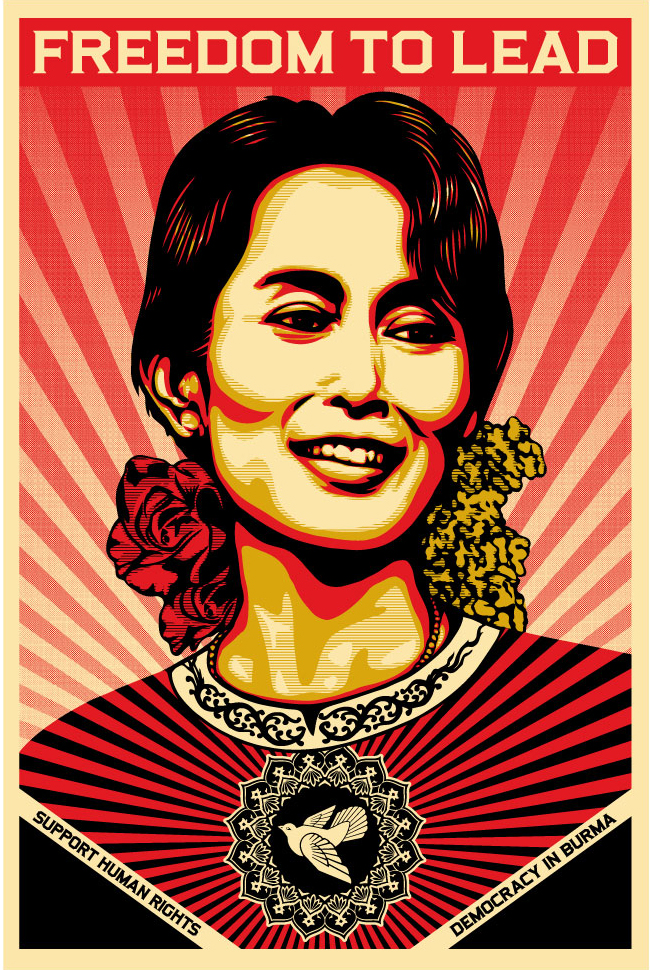
The Lady on the relationship between empowerment & dignity

I first learned about the situation in Burma/Myanmar more than ten years ago, when I was stopped by a student activist from the Free Burma Coalition (now the US Campaign for Burma). Since that first, fateful introduction, I’ve spent thousands of hours reading, writing, interviewing, photographing and exploring the deep complexities of the country, its peoples and its impact on the world. From covering the role of technology in the Saffron uprising for MobileActive, publishing a chapter called Burma, A Modern Anomaly for ‘Mobile Technologies for Conflict Management’ to my recent article on the incredible victories of the Burmese BarCamp community, I have learned so very much from the many Burmese people within and outside of the country I have met over the years.

I continue to learn from one Burmese person in particular, although I have never her in person. I first read Aung San Suu Kyi’s Freedom from Fear shortly after I first learned of the situation in Burma. At the time the Nobel Peace Prize winner & rightful winner of the 1990 National Elections was under house arrest, a state she has been in for most of the past 10 years. It is astonishing to consider just how many changes have occurred since then … even a year ago, it would have been astonishing to think that Aung San Suu Kyi, known as the Lady, would be running for parliament, or have given the keynote speech at BarCamp Yangon.

I recently came across this video of the Lady speaking on the relationship between empowerment and human dignity. Both concepts can seem vague and difficult to define at times … because the audio was slightly difficult to discern, I transcribed her words.

Power is something that comes from within … for you to achieve that kind of power from within, you need to believe in your own dignity as a human being. If you have not upheld that dignity, you will not have the clear conscience that will enable you to feel empowered. So I think the basic connection between dignity and empowerment is the human connection. Are you a dignified human being? Have you lived up to your human dignity? And if you feel you have dignity, you naturally feel strong, because you’re confident in what you have done & what you stand for. And that empowers you.

… Human dignity is at the foundation of human rights. In the preamble to the United Nations Universal Declaration of Human Rights, there is talk about the essential need to recognize everybody’s dignity as a human being.

comment 0

Return to Chiapas

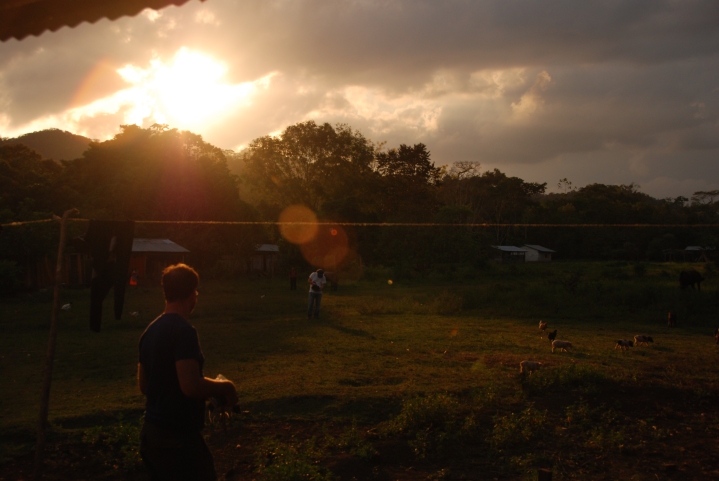
Both literally & figuratively, Chiapas is the bridge between Mexico and central America. Mexico’s southern-most state, it has a curious and complicated history of politics, land tenure and cultural clashes. It’s also an incredibly beautiful land of jungle and mountain highlands, both ecologically and culturally rich.

I first journeyed to Chiapas ten years ago this month on an alternative spring break trip my freshman year at American University. Now I’m back, setting up a pilot project for Digital Democracy where we are focusing on media & communications with indigenous communities under threat of eviction from the Mexican authorities.

I’m thinking a lot these days about agency, voice and narrative. The power of stories to perpetuate conflict, or help us transcend it. As I prepare to go offline the next few days into remote communities far from electricity, internet or cell phone reach, I’m aware I have as much or more to learn as I have to teach.

comment 0

Snow in Madrid, decades later

Happened upon this haunting image of Joy Davidman, taken by one of my heroines, Lotte Jacobi. Davidman was a poet, a communist, an intellectual, an independent woman. Accomplished in her own right, eclipsed by the fame of her second husband, C.S. Lewis.

Read more about her life.

Snow in Madrid – Joy Davidman

Softly, so casual,

Lovely, so light, so light,

The cruel sky lets fall

Something one does not fight.

How tenderly to crown

The brutal year

The clouds send something down

That one need not fear.

Men before perishing

See with unwounded eye

For once a gentle thing

Fall from the sky.

comment 0

Summer Share

Yesterday was the first summer share of the season. I felt like I had won the lottery putting it all in bags & bringing it home. All told:

1.5 dozen eggs

1 bunch of fresh lavender

2 quarts of strawberries

1 pint of sugar snap peas

1 head of lettuce

1 head of bok choy

1 bunch of asparagus

1 bunch of broccoli rabe

1 bunch of radishes

What a feast! Also picked up pumpernickel bread, cheese, sorrel, ramps & juice at the market.

comment 0

Update from Port-au-Prince

It’s Sunday evening in Port-au-Prince and the temperature has cooled after a hot day. I’ve only been here since Friday, but already I feel immersed in so much news, updates and complexities. Some things have changed in the three months since I’ve been here. So much has not.

Many news organizations, from CNN to AP have taken the 6 month anniversary of the earthquake earlier this month to report on how little rubble has been cleared. I don’t know how they’re keeping track, but certainly very little seems to have been removed from the roads and camps and I know from April.

The General Hospital, on the other hand, is markedly different. In April, it was bustling with activity (even on a Sunday) and tents outside the buildings were filled with people. There were other problems, too – staff hadn’t paid since October of last year. Today, another Sunday, it was clear they’ve made great strides. The Haitian staff are now being paid, the tents have been removed, and the campus seemed quite clean and orderly … a paradise compared to the nearby Champ Mars camps which have surrounded the crushed National Palace since January.

Meanwhile, the epidemic of violence against women – specifically rapes (mostly by strangers) in the camps – continues. At a meeting of Kofaviv (Commission of Women Victims for Victims) which I attended on Friday, five women reported being raped in the past week. A 25-year-old with an adorable daughter told how she was gang-raped. An 8-year-old introduced herself – she is also a victim.

How can I even process this information? How can you? I’m not sure I can. I repeat these stories just to make them real, in my own mind. To bear witness. To not forget.

I accompanied another group, Favilek (Women Victims Get up Stand up) to distribute additional whistles to a camp where they’ve been working. After two taxi drives and a hike up an utterly destroyed road, we reached the Camp Bo Marché. It’s in a hilly area of Port-au-Prince that was badly hit by the quake. As we walked around, speaking to women and handing off the plastic whistles, our guides kept showing us the problems – the ragged states of their tents, the lack of protection against tropical storms, how close their quarters were. I saw women bathing and dressing as I walked through the space.

But the women in Bo Marché also talked of how useful the whistles have been in preventing intruders from attacking women in their tents. One said she tells her friends to always have the whistle nearby – “treat it like your flashlight & phone.” Another explained that when one person starts using the whistle in the night, everyone nearby will use hers as well to surround a would-be attacker and provide protection. When we asked how they provide protection, they vaguely mentioned people with machetes. No – really.

Our partners the Institute for Justice & Democracy in Haiti and Madre will be releasing their report within the week from their fact-finding mission on the issue of Rape in Haiti. We’re collaborating with them and the awesome New Media Advocay Project on a Rape Accountability and Action Project. While I’m here, I’m talking with the women about how mobile phones and other tools can aid their work, building off of the model of Handheld Human Rights in Southeast Asia.

There are no easy answers but it’s truly an honor to be working with these women. Their grace under pressure and willingness to share harrowing stories in pursuit of justice has been quite an honor to witness. You can keep up with all of this work on the Digital Democracy website – http://www.digital-democracy.org.